
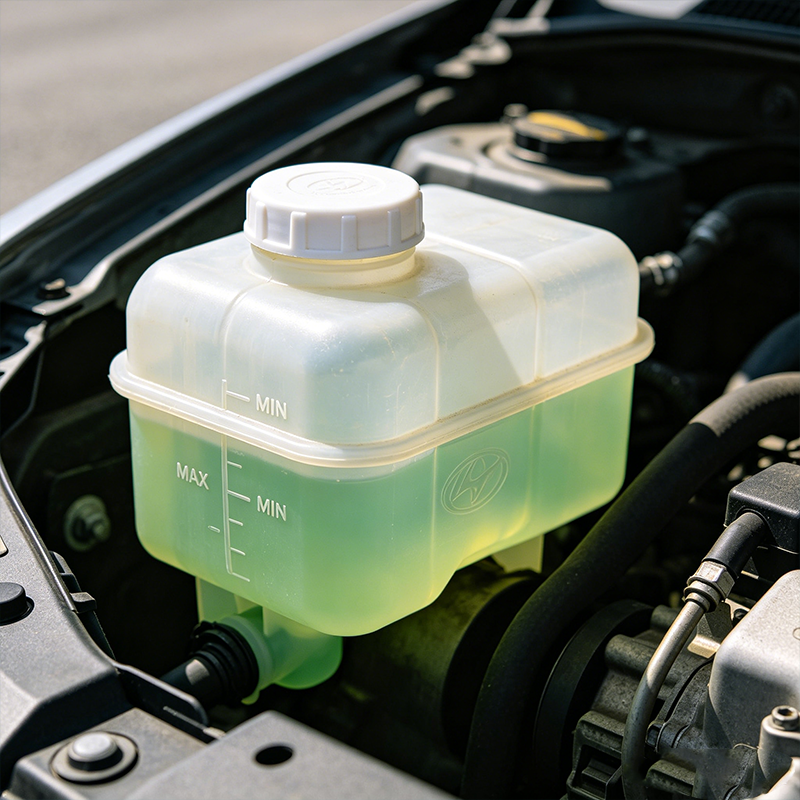
OEM projects demand durability. A coolant reservoir must withstand heat, pressure, and chemical exposure. Material choice directly impacts failure rates, warranty costs, and customer satisfaction. This guide compares polypropylene (PP), polyamide (PA), and aluminum. It also includes case studies from Carstar. Engineers will find specific data on thermal limits, chemical resistance, and cost structures.
Why Material Selection Determines Reservoir Longevity
Coolant reservoirs face three simultaneous stresses.
Thermal stress. Engine bay temperatures range from 90°C to 150°C depending on engine type, turbocharging, and ambient conditions. Coolant itself cycles between ambient temperature and 120°C. Each heat cycle expands and contracts the reservoir material.
Mechanical stress. Pressurized cooling systems operate at 1.0 to 1.5 bar. Some heavy-duty applications reach 2.0 bar. This pressure applies constant hoop stress to reservoir walls. Weak materials creep or bulge over time.
Chemical stress. Coolant contains ethylene glycol, corrosion inhibitors, and pH stabilizers. Some plastics degrade when exposed to these chemicals for thousands of hours. Hydrolysis breaks down polymer chains. The result is surface cracking or complete material failure.
Therefore, coolant reservoir material selection for OEM projects requires balancing these three factors. No single material excels in all areas.
Polypropylene (PP). Properties and Limitations
Polypropylene is the industry baseline. Approximately 70% of OEM coolant reservoirs use PP. Understanding its limits prevents misapplication.
Thermal performance. Homopolymer PP has a heat deflection temperature (HDT) of approximately 100°C at 0.45 MPa. Copolymer PP reaches 105°C. Above these temperatures, PP softens. Long-term exposure at 110°C accelerates embrittlement. After 2,000 hours at 120°C, tensile strength drops by 40%.
Chemical resistance. PP resists ethylene glycol and most coolant additives. It does not hydrolyze easily. However, strong oxidizers in some long-life coolants can attack PP. Testing with the specific coolant formulation is required.
Mechanical properties. Tensile strength ranges from 30 to 40 MPa. Elongation at break is 100% to 600% for fresh material. After heat aging, elongation drops below 50%. The material becomes glass-like. Impact resistance falls sharply.
Cost. Raw material cost is $1.20 to $1.80 per kilogram. Molding cycles are fast, typically 30 to 60 seconds per part. Tooling costs are moderate.
When to use PP. Naturally aspirated passenger cars. Coolant temperatures below 105°C. Expected service life of 5 to 8 years. High production volumes above 100,000 units per year.
When to avoid PP. Turbocharged or diesel engines. Towing applications. Any environment where coolant exceeds 110°C regularly.
Polyamide (PA). High-Heat Alternative
Polyamide, commonly nylon, handles higher temperatures. Two grades appear in coolant reservoirs: PA66 and PA6.
Thermal performance. Heat deflection temperature for glass-filled PA66 is 250°C at 0.45 MPa. Continuous use temperature is 130°C to 150°C. Short-term exposure to 160°C is acceptable. This makes PA suitable for turbocharged and diesel applications.
Chemical resistance. PA absorbs moisture. Saturation can reach 2.5% to 3.0% by weight. This absorption causes dimensional changes of 0.5% to 1.0%. For reservoirs with tight mounting tolerances, this matters. PA also resists ethylene glycol well but requires stabilization against hydrolysis. Hydrolysis-stabilized PA grades are available.
Mechanical properties. Glass-filled PA66 achieves tensile strength of 100 to 150 MPa. Elongation at break is 2% to 5%. The material is stiff and strong. Weld line strength is higher than PP, reducing seam leak risks.
Cost. Raw material cost is $2.50 to $4.00 per kilogram. Molding cycles are similar to PP, approximately 40 to 70 seconds. Tooling costs are comparable.
When to use PA. Turbocharged gasoline engines. Diesel engines. Heavy-duty trucks. Coolant temperatures between 110°C and 130°C. Service life requirements of 10 to 15 years.
When to avoid PA. Applications with extreme humidity cycling. Unstabilized grades in long-life coolant formulations. Cost-sensitive low-end vehicles.
Aluminum. Premium Choice for Extreme Conditions
Aluminum reservoirs appear in racing, heavy-duty commercial, and luxury applications. The most common alloy is 6061.
Thermal performance. Aluminum has no heat deflection limit. Continuous operation at 150°C causes no degradation. Thermal expansion is 23 ppm/°C, which is predictable and manageable.
Chemical resistance. Bare aluminum corrodes in coolant. Therefore, all aluminum reservoirs require internal coating or anodizing. Silicate-based coolants provide additional protection. Without proper coating, pitting corrosion occurs within months.
Mechanical properties. Tensile strength of 6061-T6 is 310 MPa. Yield strength is 275 MPa. Burst pressure typically exceeds 10 bar. No creep or stress relaxation over time.
Cost. Raw material cost is $3.00 to $5.00 per kilogram. However, fabrication costs dominate. Welding adds $5 to $15 per part. Coating or anodizing adds another $3 to $8. Total cost per unit is $20 to $50 even at volume.
When to use aluminum. Racing applications. Commercial trucks with million-mile service life. Luxury vehicles where appearance justifies cost. Coolant temperatures above 130°C.
When to avoid aluminum. High-volume passenger cars. Any application where cost per part exceeds $15. Uncoated applications.
Material Comparison Summary
The following comparison consolidates key metrics across three materials.
Maximum continuous temperature. PP handles 105°C. PA handles 140°C. Aluminum handles 150°C or higher.
Tensile strength. PP offers 30 to 40 MPa. PA offers 100 to 150 MPa. Aluminum offers 310 MPa.
Cost per kilogram. PP costs $1.20 to $1.80. PA costs $2.50 to $4.00. Aluminum costs $3.00 to $5.00.
Cost per finished part at 50,000 units. PP costs $4 to $8. PA costs $6 to $12. Aluminum costs $20 to $50.
Service life expectation. PP lasts 5 to 8 years. PA lasts 10 to 15 years. Aluminum lasts 20 years or more.
Failure modes. PP fails by embrittlement and cracking. PA fails by hydrolysis or moisture swelling. Aluminum fails by corrosion if uncoated.
Common Material Failures in OEM Projects
Understanding failure mechanisms prevents repeat mistakes.
Heat aging embrittlement in PP. After 1,500 to 2,000 hours above 110°C, PP loses plasticizers. The material becomes brittle. A small impact or pressure spike causes catastrophic cracking. Solution: Use heat-stabilized PP or upgrade to PA.
Hydrolysis in unstabilized PA. Coolant breaks amide bonds in PA over time. Tensile strength drops. Surface cracks appear. Solution: Specify hydrolysis-stabilized PA grades such as PA66 HR.
Weld line failure in both plastics. Reservoirs are molded in two halves and welded. If weld parameters drift, seam strength drops. Failure occurs at the weld line. Solution: Implement in-process weld inspection. Use thicker flanges.
Neck cracking from cyclic torque. Cap tightening and removal create cyclic stress at the neck. Thread roots act as stress concentrators. Cracks initiate at thread roots. Solution: Add a metal threaded insert. Increase neck wall thickness to 4 mm minimum.
Carstar Case Study 1. PP to PA Upgrade for Turbocharged Engine
A North American truck manufacturer experienced coolant reservoir failures at 40,000 to 60,000 miles. The original design used heat-stabilized PP. The engine was a 3.5L turbocharged V6. Data logging showed coolant temperatures reaching 118°C during towing and mountain driving.
Carstar received failed samples for analysis. Fracture surface examination showed brittle cracking. Differential scanning calorimetry confirmed the PP had lost 60% of its original elongation. The material had heat-aged beyond its useful life.
Carstar proposed a redesign using 30% glass-filled, hydrolysis-stabilized PA66. The new design also added rib reinforcement at the neck and increased wall thickness from 2.5 mm to 3.0 mm.
Prototype testing included 3,000 heat cycles from -40°C to 130°C. The PA reservoirs showed no cracks. Burst pressure increased from 3.2 bar to 5.1 bar. The truck manufacturer approved the change. Production switched to Carstar PA reservoirs. Failure rates dropped to near zero.
More case studies are available at https://carstarauto.net/.
Carstar Case Study 2. Aluminum Solution for Desert Racing
A desert racing team needed a coolant reservoir that would survive 1,000 miles of rough terrain. Ambient temperatures reached 50°C. Coolant temperatures exceeded 130°C. The team previously used PP reservoirs. Each race ended with a cracked tank and lost coolant.
Carstar designed a 2.5-liter aluminum reservoir using 6061-T6 sheet. The design included internal baffles to reduce slosh. The filler neck used a welded boss with NPT threads. A sight glass allowed level checks without opening the system.
All internal surfaces received a silicate-based electroless nickel coating. This coating withstood coolant pH swings from 7.5 to 11.0. The exterior was left raw for weight savings.
The team tested the reservoir for two full racing seasons. No failures occurred. The same reservoir completed eight races. The team now uses Carstar aluminum reservoirs across their entire fleet.
Testing Protocols for Material Validation
Material selection without testing is speculation. These tests validate any coolant reservoir material.
Heat cycle test. 2,000 cycles from -40°C to operating temperature plus 20°C. Cycle duration is 60 minutes at each extreme. Inspect for cracks every 200 cycles. Maximum allowable cracks: zero.
Pressure cycle test. 50,000 cycles from 0 to 1.5 times maximum operating pressure. Frequency is 30 cycles per minute. Measure permanent deformation every 10,000 cycles. Deformation above 2% is failure.
Burst test. Ramp pressure at 0.1 bar per second until failure. Acceptable burst pressure: PP minimum 3.5 bar, PA minimum 4.5 bar, aluminum minimum 8.0 bar.
Chemical immersion test. Submerge material samples in operating coolant at 120°C for 3,000 hours. Measure tensile strength and elongation before and after. Retention above 70% is acceptable.
Vibration test. Mount filled reservoir on a shaker table. Apply 10 to 500 Hz sweep at 2G for 200 hours. Inspect mounting bosses and weld lines for cracks.
Carstar performs all five tests on every new reservoir design. Test reports are available to OEM customers.
Design Guidelines for Each Material
Optimizing design for the chosen material extends service life.
For PP designs. Wall thickness minimum 2.5 mm, preferably 3.0 mm. All corners radius minimum 3 mm. Add ribs around the neck. Use a metal insert in the neck for high-torque applications. Avoid sharp changes in section thickness.
For PA designs. Wall thickness minimum 2.0 mm. Add glass fiber orientation markers on the mold. Dry PA parts at 80°C for 4 hours before assembly to stabilize dimensions. Use hydrolysis-stabilized grades for long-life coolant.
For aluminum designs. Wall thickness minimum 1.5 mm. Use 6061-T6 or 5052-H32 alloys. Specify internal coating thickness of 25 to 50 microns. Design for drainage to prevent coolant pooling. Use welded bosses, not threaded inserts.
Cost Optimization Strategies
Balancing material cost against failure risk requires analysis. Here is a framework.
Calculate total cost of ownership for the reservoir. Include warranty costs. A PP reservoir costing $5 with a 5% failure rate generates $0.25 in expected warranty cost per unit. A PA reservoir costing $9 with a 0.5% failure rate generates $0.045 in warranty cost. The PA solution costs $4 more upfront but saves $0.205 in expected warranty.
For high-volume production above 500,000 units, PP is usually optimal. For medium volume between 50,000 and 500,000 units, PA becomes competitive when failure rates exceed 3%. For low volume below 50,000 units, aluminum tooling costs are lower than plastic injection molds, making aluminum viable.
Carstar provides cost modeling for each OEM project. They factor in material, tooling, production, shipping, and warranty data.
Final Technical Recommendations
Select PP when maximum coolant temperature stays below 105°C and production volume exceeds 100,000 units per year.
Select PA when coolant temperature reaches 110°C to 130°C or required service life exceeds 8 years.
Select aluminum when coolant temperature exceeds 130°C or appearance is a selling feature.
Always request heat-stabilized PP or hydrolysis-stabilized PA. Always test with the exact coolant formulation. Always validate with heat cycling and pressure cycling.
Carstar supplies all three material types. Their engineering team assists with material selection, prototype testing, and production scale-up. Visit https://carstarauto.net/ for technical datasheets and case studies


